These are just general ideas for learning vocabulary that can be used for almost any topic.
With objects:
I like to use toy animals. I have quite a collection of Schleich animals. Depending on where you are teaching, there may be material you can use there. I have also used objects for other topics (for example fruits and vegetables or construction equipment) quite successfully.
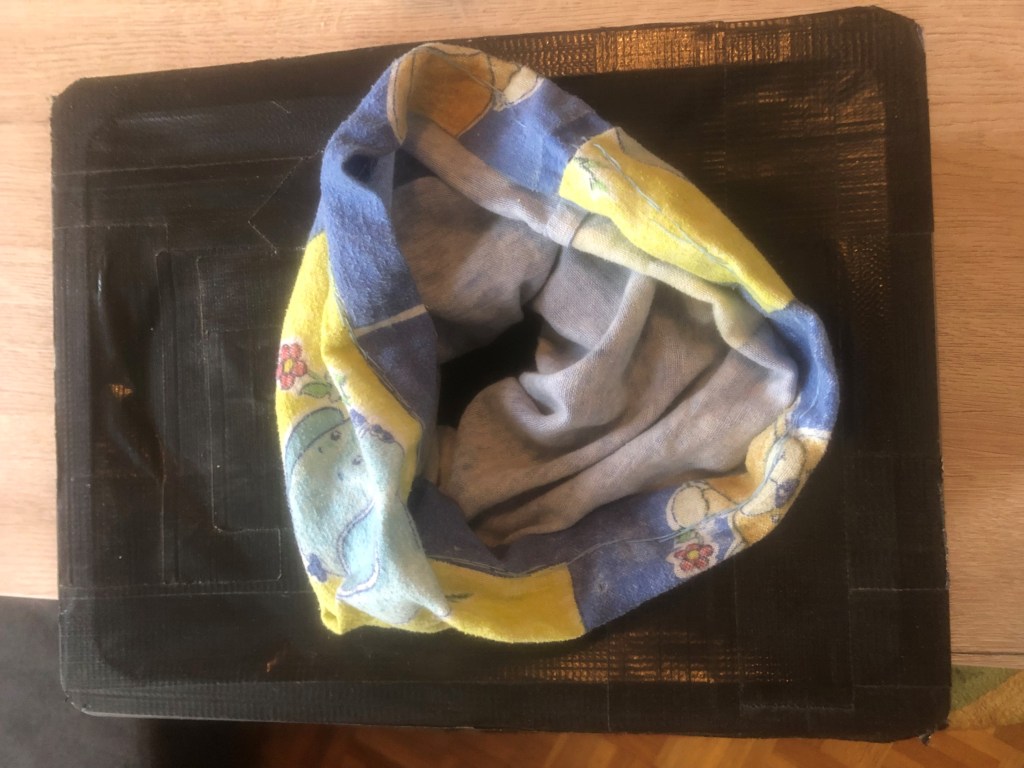
Most of the games can be used for objects or picture cards, but kids love to hold things in their hands. Uniquely with objects are games where they try to guess what it is by feel. You can either put the objects in a bag or create a box. I took a plastic storage box (I used black, but any color will do as long as you cannot see through it), cut a hole in the top and duct-taped an old pillowcase cut into a tube onto the top. Kids can then reach in and guess what they have in their hand. Another option is to blindfold the child and put the object in his hand.
With picture cards:
- I say, you say: This is usually the first stage in our vocabulary learning. I say a word and the kids repeat it. Our standard signals are the thumb pointed to me means I speak, finger to them, they speak. Sometimes after we have repeated a few times I will simply point to the picture then to them and see who remembers to say it.
The next level in this stage is that they have to say the word exactly the way I do. I am loud or quiet, high or low, happy, sad, angry, etc. We often act out an entire mini drama using only one word.
- I say, you point: Exactly what it seems to be. I say a word, the child points. If I have an entire classroom, I might get them involved as well. If the child points to the correct one, the class says “Bing!”. If it is the wrong one, the class makes a short buzzer sound. I also tell the child at the board that they can point to the wrong one on purpose at any time to make sure the other kids are paying attention. This especially helps weaker kids not to feel exposed. Another variant is to hang the pictures around the classroom and have the entire class stand up and point to what I say.
- Who is faster?: Two children are at the board. A third keeps score and lets me know when one child has three points. I say a word and whoever touches the card (or object) fastest wins. NO switching! What the child touches first counts.
- Where is the….?: This game has a version for small groups and one for classrooms.
In small groups I will take three cards and place them in front of the child. In the first step, I go from child to child and say one word to each, having them point to it. I tell them we are now playing a game where all of them are playing against me. Then I go back to the first child, name all three cards and name them again while turning them over. I tell them “Find watermelon.” with my hand on the back of the correct card, then mix the cards around. I ask them “Where is the watermelon?” If the child guesses correctly, the children get the point. If they are wrong, I get the point.
In classrooms I will put up to five cards on the board and write numbers over them. Then I will ask “What number is watermelon?” or “What is number 3?” I then turn the cards so that the pictures cannot be seen and do the same thing. Then I take the cards off the board, shuffle them, and hang them up (again without the pictures visible) and ask.
- The chain: a child comes to the board, where all the pictures cards we are doing are hanging. Then I say a word and she points. I say that word and another and she must point to both in the correct order. I keep adding words to the chain, saying all of them every time and the child must point at them after I finish, again in the correct order (I also repeat words I have already used or say the same word twice in a row). When they make a mistake, other kids who think they can do it raise their hand and the child at the board chooses her successor, who must come forward and point to the chain without me repeating it. This is a great game to get them hearing difficult words multiple times, and for paying attention even when it isn’t their turn as it could be at any moment.
- Put them in order: A variant of the chain that moves up in levels. A child is at the board. Level one is “three cards, with repeats”. This means I say three of the cards that are on the board and the child has to line these up in order on the other side of the board. With repeats means that while he is doing this, we continue to repeat the three. If he has put an incorrect card in the order, we say this one more loudly, until they are all lined up correctly. A new child comes to the board and we have “three cards, no repeats”. I say the three twice, then the child must line them up. If she does not get it right, another child can try (without me repeating them). This continues through “four cards, with repeats”, “four cards, no repeats”, “five cars, with repeats”, until no child can solve the puzzle or dares to try. It usually stops by six at the latest.
- What is it?: I stand at the front of the room with all the cards. I flip one towards the children very quickly, and whoever says it first gets the card. This can get somewhat loud and wild. I tell them at the beginning that it is who I hear first, not who is loudest or says it most often. I also tell them that if they speak instead of yelling, I will recognize their voice more quickly. Usually once a child has a card, they may not say another one.
- What’s missing?: The objects are placed in a bag or the cards on the board. Then one card or object is removed. (With objects I will take one out of the bag where I cannot be seen then dump the rest of the objects out. when playing with objects, I will have two children playing against each other at the front of the class). If it is a board that can be shut I remove the picture behind the board. Otherwise, I have the children lay their heads in their hands while I remove one. Then I ask, “What’s missing?” The children raise their hands to answer.
- Point, swap, give: A child comes to the board, where all the pictures are hanging, and I give commands. “Point to the cow.” “Swap cow and horse.” “Give horse to Peter.” Then another child will come to the board and the process is repeated until there are no more cards on the board. I might then say, “Swap cow and pig.” And the two children who have these will trade.
- Collecting the cards: There are a few different games for getting cards back to me. The cards (or objects) may be out from “What is it?” or from “Give it to..”, or I may have simply handed them out in the classroom.
I ask the children who have the card to lift their card when I say the word. Once I have gone through all of them, I have them stand up and turn in a circle with the card when I say the word. Then they turn the card face down on the desk. A child without a card goes to another and says, “Cow, please.” If that child does not have the card, he says, “No, sorry.” If he does, he hands it to the girl and says “Here you are.” She says, “Thank you.” He says, “You’re welcome.” Repeat as long as desired.
Begin as above, or after playing as above leave the cards with the children. Choose a stronger pupil and see how many cards he can collect by going to the correct child and asking for them. He may continue until he makes a mistake, then it is the next child’s turn.
I say two words. These two children must run to me with their cards. Whoever is there faster gets her card hung on the board. The other child returns to his seat with his card and will be called again at some time. Repeat until all cards are on the board.
- Lift and Show: I hand the cards out in the classroom, and the children with cards come to the front. It is always “I say, you lift”, so whichever word I have said, the appropriate card should be lifted and lowered. For level one I stare at whatever child has the card I am saying. For level two I stare at a different child (so if I stare at you, you know it is not your card). At this and the next level, if a child does not know it is her card, the class can help by saying her name. At level three it does not matter where I look. The cards are lifted until I blow my whistle (or ring a bell, or clap my hands). Then each card is passed one further down the line, with the last card going to the first child. After a few rounds, the children at the front give the cards to children who are seated, and the game continues.

 English 4 Kids